
Spain leads the way in economic growth among the major economies of the eurozone, recording GDP growth rates that consistently exceed the regional average. However, behind the impressive macroeconomic figures celebrated by government departments and international organisations, commercial courts and corporate services firms paint a radically different picture. The traditional correlation taught in economics textbooks — the one that dictated that higher GDP growth leads to fewer bankruptcies — has been completely broken.
Recent data confirm this technical disconnect. Whilst national wealth is consolidating robust growth, insolvency proceedings and bankruptcy filings remain at unusually high levels. How is it possible that a country growing at a remarkable rate is destroying and driving companies into insolvency at a similar pace?
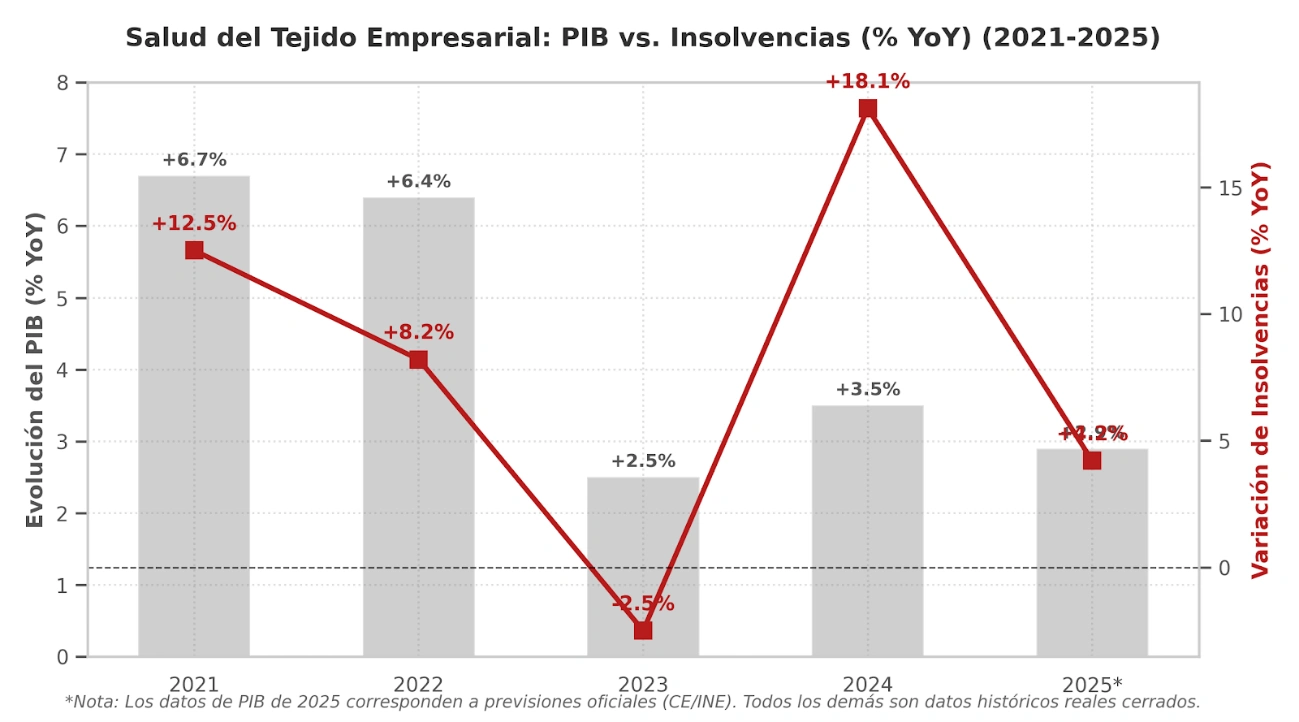
The macroeconomic mirage: Not everyone benefits from growth
The first factor explaining this asymmetry is that GDP is an aggregate indicator that often acts as a mirage. The current strong momentum of the Spanish economy is overly concentrated in sectors such as tourism, high value-added services and public spending. However, the mainstream business sector, comprising mainly small and medium-sized enterprises (SMEs), operates in a parallel reality.
These organisations are suffering the delayed impact of inflation that has eroded their profit margins, rising labour costs and tight financial conditions with interest rates that sometimes strangle their cash flow. GDP is rising because the major national champions are generating more revenue than ever, but thousands of smaller companies are not sharing in that boom.
Corporate Darwinism and technological disruption
Added to this growth gap is a phenomenon of ‘weeding out’ or corporate Darwinism. During the years of zero interest rates and post-pandemic government relief schemes, many structurally unviable companies managed to survive artificially. The definitive withdrawal of these stimuli and the tightening of bank credit have accelerated the decline of businesses that were already struggling.
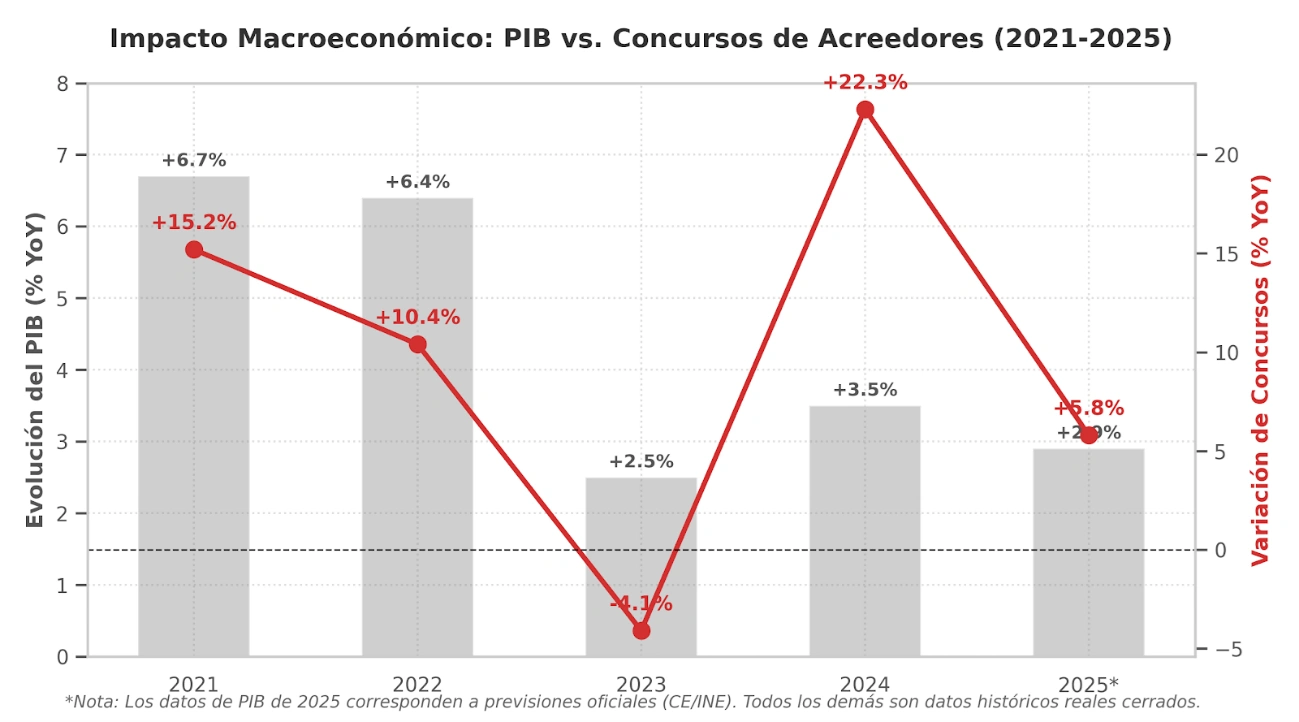
On the other hand, the pace of change within the sector is rendering obsolete business models obsolete overnight. The widespread adoption of artificial intelligence and the forced shift towards digitalisation are forcing companies to make capital investments that many vulnerable firms cannot afford, thereby accelerating their path to insolvency.
Restructuring goes hand in hand with efficiency
However, the high number of insolvency proceedings and bankruptcies may conceal a profound cultural shift. Traditionally, in the Spanish business world, insolvency proceedings were seen as a company’s death certificate; a stigmatised process that almost always ended in a traumatic liquidation.
Today, the business mindset has undergone a Copernican shift. Thanks to much more flexible regulatory frameworks geared towards business continuity, insolvency is no longer seen as a definitive failure, but rather as a technical window of opportunity. Increasingly, companies are choosing to take pre-emptive action and restructure their liabilities as a preventative measure, rather than waiting for the final collapse.
Restructuring has become synonymous with operational efficiency and resilience. In a hyper-competitive environment, reorganising debt, downsizing workforces and optimising assets is the only way to safeguard jobs and ensure long-term viability. Overcoming the fear of restructuring and normalising its use could, paradoxically, be the most effective mechanism for individual companies to finally align themselves with the healthy performance of the macroeconomy.